
When the Contractor Should Join the Project
Every building project eventually arrives at the same moment: the drawings are finished, the bids are opened and everyone finds out what the project actually costs.
Sometimes that moment is a relief. Sometimes it is the beginning of a redesign.
The difference often has less to do with the design itself and more to do with when the contractor was invited into the conversation.
That timing is set by the project delivery method—the structure that determines who is hired, when they are hired and who carries which risks. It sounds like a contract detail.
In practice, it decides when the price of your project becomes real.
Design-Bid-Build: The Price Arrives Last
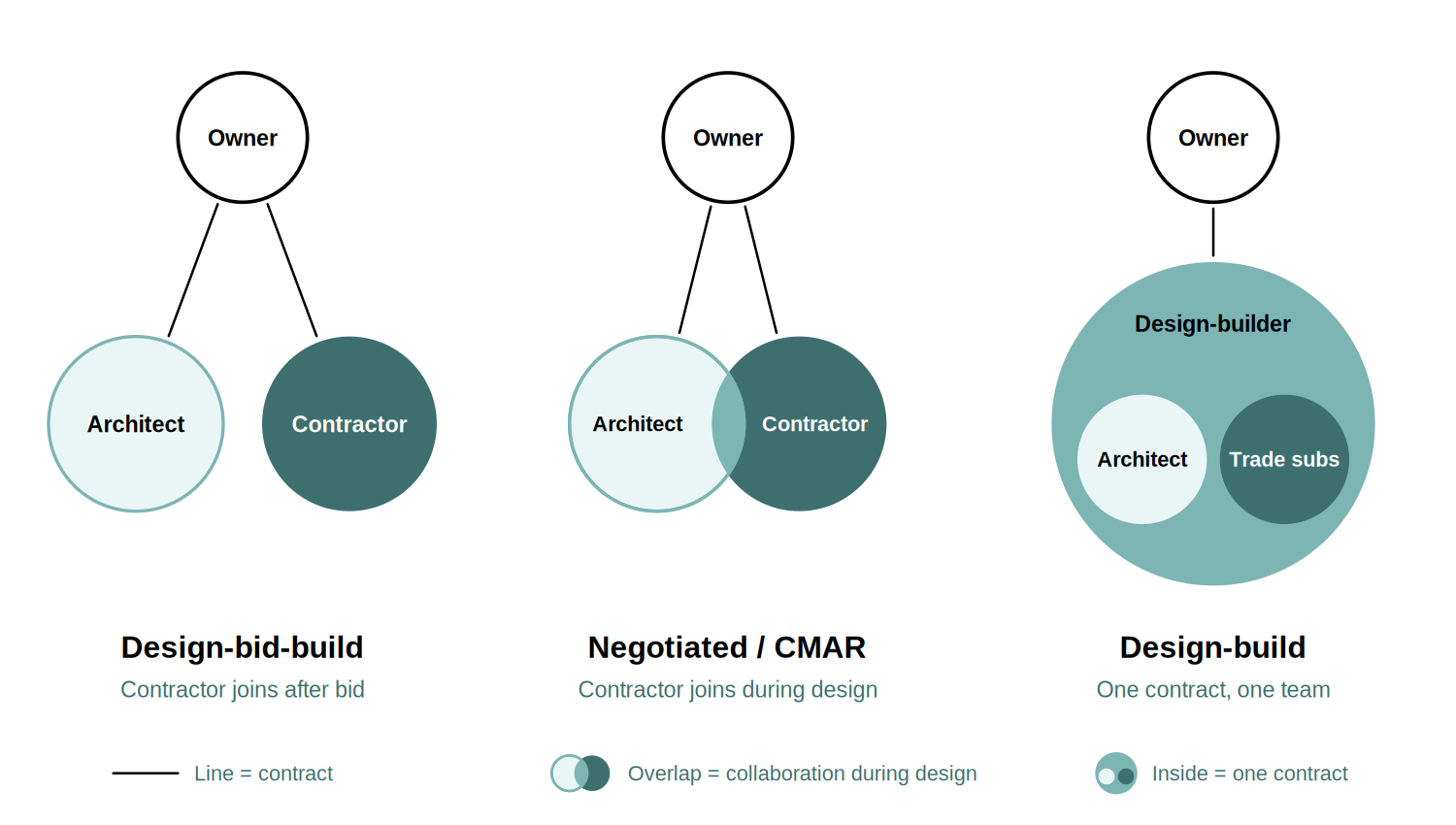
Design-bid-build is the method most people picture when they think about construction. The owner hires an architect, the design team completes a full set of construction documents and those documents are issued for bidding. Contractors price the drawings, the owner typically selects the lowest responsible bidder and construction begins.
The method has lasted for good reasons. Roles are clearly separated. The drawings define the scope. Competitive bidding creates price pressure, and many public owners are required by procurement rules to use it.
The challenge is timing.
During design, the project usually relies on estimates built from historical cost data and cost-per-square-foot assumptions. Those numbers are useful for early planning. They are not aware that your site has rock two feet below grade or that the electrical switchgear you need has a lead time longer than your construction schedule.
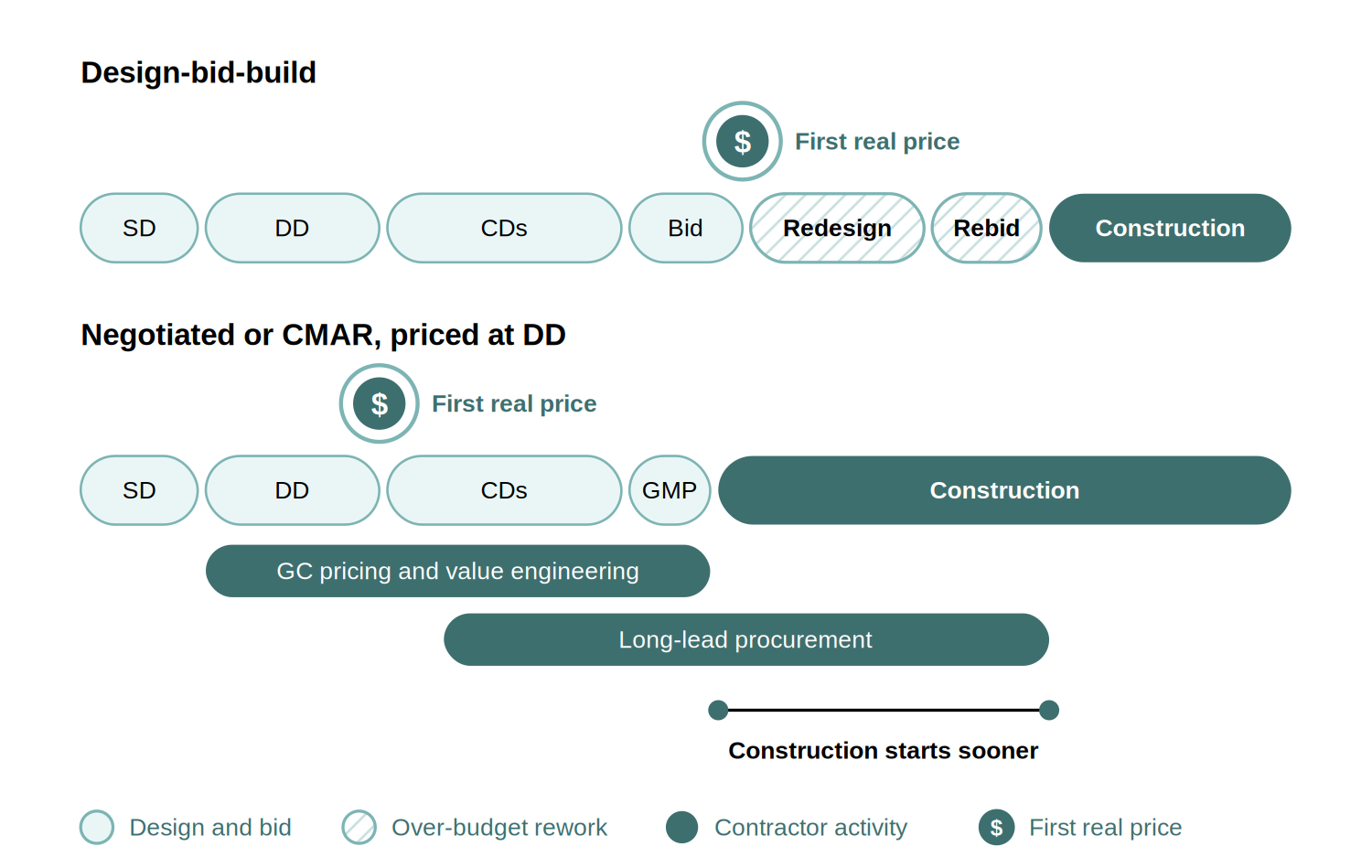
The first truly reliable price arrives after the design is complete. If the bids come in over budget, the options are limited: find more money, reduce the scope or redesign and rebid. That last option can add weeks or months, and the drawings that took the longest to produce are now the ones that need to change.
Design-bid-build answers the cost question with great precision. It just answers it last.
Negotiated: Choose the Contractor, Then Build the Price
In a negotiated project, the owner selects a contractor based on qualifications, experience, fees and fit rather than a lump-sum bid on finished drawings. The price is then developed together, commonly as the cost of the work plus a fee, often with a guaranteed maximum price (GMP) established once the design is far enough along.
A common concern is that negotiating means giving up competition. It doesn't. The contractor still bids the work to subcontractors, and the trades are where most of the construction dollars actually live.
Competition doesn't disappear. It moves to where most of the money is.
The real advantage is that the contractor is on the team while design decisions are still inexpensive to change.
Construction Manager at Risk
Construction manager at risk (CMAR) is a more formalized version of the same idea. The construction manager is hired during design to provide preconstruction services—estimating, scheduling, constructability review and procurement planning. Later, the construction manager commits to a GMP, holds the trade contracts and takes on the risk of delivering the work within that price.
CMAR is widely used in healthcare, education and other project types where budget certainty and schedule both matter, and many public owners have statutory authority to use it.
A related approach, sometimes called CM agency, or owner's representative, places a construction manager in an advisory role without holding the construction contracts or the cost risk.
Design-Build: One Contract, One Team
In design-build, the owner contracts with a single entity responsible for both design and construction. The architect and contractor work together from the start, and the owner has one point of responsibility.
Design-build can move quickly and works well for straightforward building types and clearly defined programs. The trade-off is that the owner typically has less direct control over design decisions, since the design team works within the builder's contract. The owner's requirements need to be well defined up front, because the details will be resolved by someone else's priorities.
Integrated Project Delivery
Integrated project delivery (IPD) brings the owner, architect and contractor into a shared agreement in which risk and reward are distributed among the team. It can be highly effective, but it requires specialized contracts and a level of collaboration that not every project—or every team—is ready for. It remains less common than the methods above.
Why Design Development Is the Right Moment
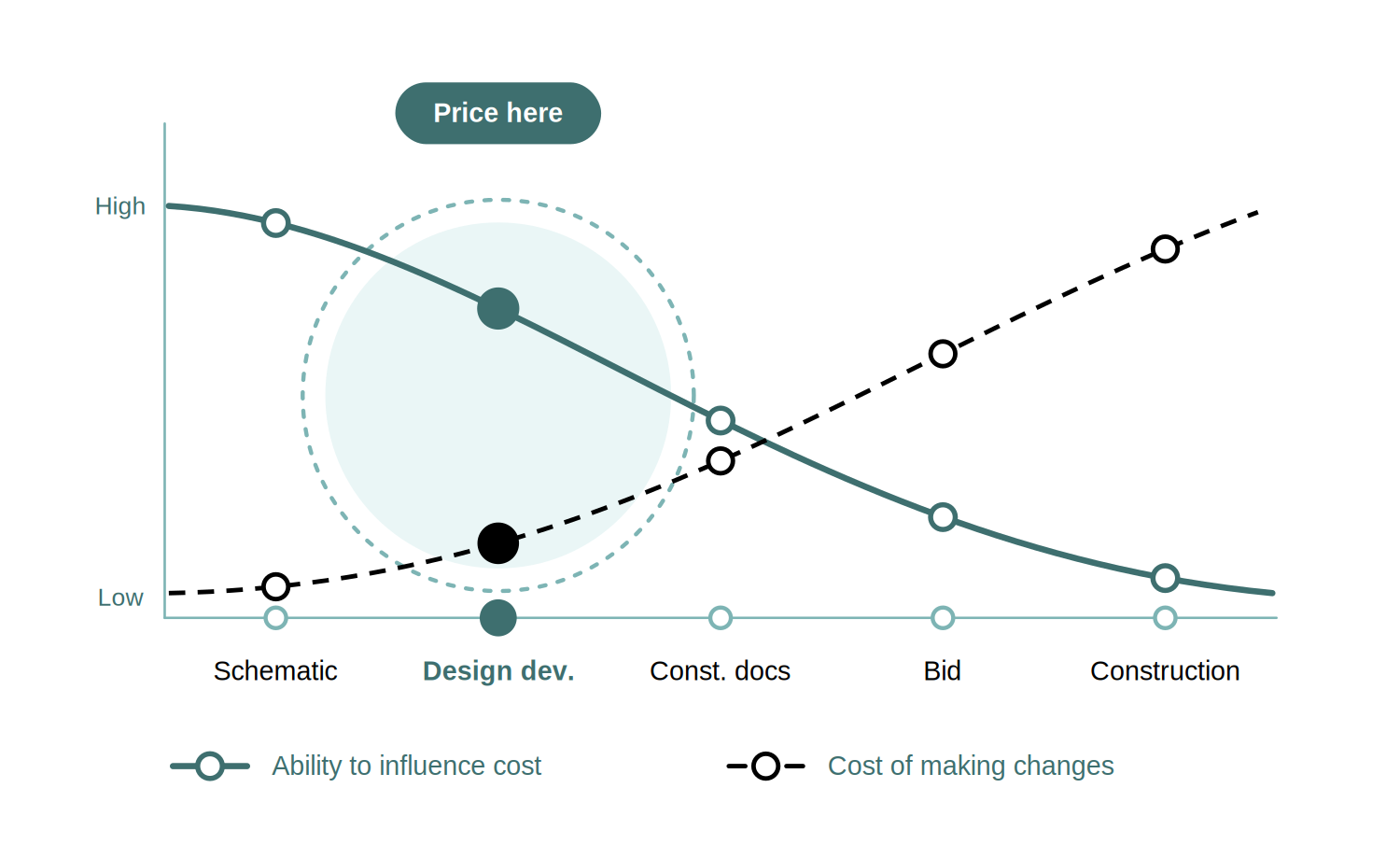
Architectural design generally moves through three phases.
Schematic design establishes the big ideas: the layout, the massing and the general approach.
Design development turns those ideas into systems. Structural framing is selected. Mechanical, electrical and plumbing approaches are defined. Wall assemblies, major materials and room layouts are coordinated.
Construction documents detail everything required for permitting and construction.
At schematic design, a contractor is pricing ideas. At construction documents, the contractor is pricing decisions that have already become expensive to revisit.
At design development, the contractor is pricing real systems while the design can still respond.
That is the moment when a cost conversation is both informed and useful.
What Early Pricing Uncovers
A contractor pricing a design development package is not just adding up quantities. They are looking for the places where the budget is exposed. Common findings include:
Site and existing conditions, such as soils, utilities or what is actually behind the walls of a building being renovated
Structural systems that are more complex or costly than early assumptions allowed
Mechanical, electrical and plumbing systems, which are frequently the largest cost variable on commercial and healthcare projects
Long-lead equipment like switchgear, generators, transformers and rooftop units
Code-driven scope, including fire protection and accessibility upgrades triggered by alterations
Gaps between what the owner expects and what the drawings currently show
Local market conditions, including subcontractor availability and pricing trends
None of these get cheaper by being discovered later. Most of them get more expensive, and all of them get more stressful.
How Early Pricing Accelerates the Whole Process
It seems counterintuitive that adding a pricing exercise in the middle of design would shorten the schedule. But the time it saves is the time most projects lose without it.
It Removes the Over-Budget Redesign Loop
The most expensive delay in design-bid-build is not the bidding period. It is the redesign that follows a bid day that went poorly. When cost exposures are identified at design development, adjustments are made before the construction documents are drawn, not after they are finished.
Decisions Get Made With Real Numbers
Owners can spend a surprising amount of time deliberating over options priced with rough assumptions. A contractor's design development estimate turns "what if" into "here is what it costs," which tends to shorten the conversation considerably.
Value Engineering Stays Engineering
Value engineering during design development is still design. The team can compare systems, adjust assemblies and preserve what matters most to the owner.
Value engineering after bid day is mostly subtraction.
Pricing and Documentation Can Run in Parallel
Instead of finishing the drawings, then pricing them, then revising them, the design team can complete construction documents with confidence that the project already fits the budget. Pricing updates can continue alongside documentation rather than waiting in line behind it.
Long-Lead Items Can Be Ordered Sooner
When the contractor identifies equipment with extended lead times, the team can plan early procurement or early release packages. Waiting for a completed bid to order a generator can quietly add months to a schedule that looked fine on paper.
Constructability and Phasing Are Considered Early
Contractors see a building in terms of sequence, access and logistics. On renovations and occupied facilities in particular, that input can shape the design itself—before the phasing plan becomes something the drawings have to work around.
Financing and Approvals Move Faster
Lenders, boards and ownership groups generally want credible numbers before committing. A design development estimate from the contractor who will actually build the project carries more weight than a square-foot projection.
A Few Caveats
Early contractor involvement is not a cure-all, and it works best when everyone understands its limits.
A design development estimate is not a hard bid. The design is not finished, so the estimate should carry appropriate contingencies and be refined as the documents are completed.
Some public owners are required to use design-bid-build. Before selecting a delivery method, it is worth confirming what the applicable procurement rules allow.
Preconstruction services may carry a fee. That cost is often modest compared to redesigning a completed set of drawings, but it should be understood up front.
Owners who worry about losing competitive pressure have good tools available: selecting the contractor through a competitive proposal on fees and general conditions, requiring open-book pricing and confirming that trade work will be competitively bid.
Finally, early involvement depends on the right relationship. It works when the contractor is a genuine partner in solving problems, not simply waiting to lock in a number.
The Real Question
Every project delivery method eventually answers the question of what a building costs. The difference is when.
Do you want to learn what your project costs while you can still shape it, or after it has already been drawn?
For many owners, the answer points toward bringing the contractor in at design development.
At LVL Design, we help owners select the delivery method that fits their project, schedule and procurement requirements. Whether the project is design-bid-build, negotiated or design-build, our goal is the same: bring cost into the conversation while the design can still respond—and make sure bid day is a confirmation, not a surprise.